Showing posts with label butterflies. Show all posts

Friday, August 6, 2010

Bugs Abound

Bugs abound in the Back Woods this summer! If you are a fan of most things Arthropoda, you might want to spend and afternoon hitting the trails, scouring the foliage, and sifting through the leaf litter in the Back Woods.

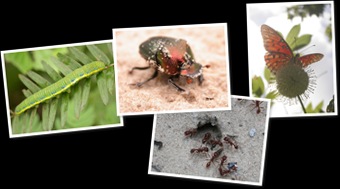
Nectaring butterflies have been the hot commodity at the Buttonbush Pond during the spring/summer bloom. The egg laying action is about to pick up in the sandhill where the partridge pea (Chamaecrista fasciculata) will prove irresistible to a variety of sulphur butterflies. The sandhill is where you will also find our very own example of Sisyphus in the rainbow scarab (Phanaeus vindex) diligently rolling up and and storing whatever piles of poo it comes across. Florida harvester ants (Pogonomyrmex badius), forever on the march, find their home in the sandhill as well.

The cicadas are most definitely turning up the volume through out the woods…look for their molts at the top of shrubs and dead  branches. Keep your focus ahead on the trails lest you walk right into the web of a tiny spiny orb weaver (Gasteracantha cancriformis) or a not so tiny golden silk spider (Nephila clavipes). One of my favorites, the green lynx spider (Peucetia viridans), looks like green glass. They don't spin a web but rather stalk the foliage for their unsuspecting prey.

Deep in the leaf litter you will likely come across all sorts of things including the real Florida palmetto bug…the Florida woods cockroach (Eurycotis floridana). These nearly wingless roaches are not considered household pests preferring the rich bounty of the outdoors to your pantry. Disturb them and they emit a very noticeable odor something like almonds or sweet amaretto.

Once you have had your buggy fill of the Back Woods don’t forget to stop off in the Bioworks Butterfly Garden for an up close look at the metamorphosis of Florida native butterflies.

Of course, the woods would not be the woods without our very own population of mosquitoes. So, use good sense as you would in any outdoor area this time of year, cover up and wear your insect repellant.

DSCN8581

Check out the Animal Species tab at the top of the page for a listing of more of the insects found in the Back Woods

Friday, November 13, 2009

Paw Paw Petals

DSCN0551 

Missing from our suite of species in the Back Woods is the Florida native dwarf paw paw, Asimina pygmea. Fortunately, they are found nearby on the westernmost undeveloped portion of the museum’s property. I captured a nice cluster of plants in bloom last week to share with our readers.

The flowers start out white then develop into a beautiful deep maroon color and are sometimes candy striped in between. The flowers are pendant along the stems developing at the leaf axis. The flowers are followed by an oblong edible yellowy green berry. Another common name for this species, gopher berry, may indicate that gopher tortoise make these an addition to their grassy diet. The larvae of Zebra Swallowtail butterfly feed on the foliage of many Asimina spp. as well.

Plans are to capture the fruit and seed of these plants to cultivate and transplant them to the flatwoods areas of the Back Woods. That is if the Med Flys don’t beat us to them ;-)

DSCN0535

Tuesday, September 1, 2009

Plant Profile: Partridge pea

Common Name: partridge pea, sleeping plant

Scientific Name: Chamaecrista fasciculata (Michx.) Greene

Form:  Annual legume (bean)

Height/Spread: 1-3 ft tall, spread similar to height.

Leaves: Alternate, evenly pinnately compound olive green leaves with small (up to 2cm) spine tipped leaflets. Leaflets fold along the rachis when touched or in response to nightfall. Two permanent stipules and a small disc shaped extra floral nectary gland are at the base of each petiole.

DSCN9008 DSCN9005

Stems: Smooth and green becoming reddish brown more haired with maturity.

DSCN9004
Flowers: Bright yellow 5 petaled flowers with red markings at the base of the petal. Stamens are sometimes red in color. One petal often folds in over stamen and anther. Flowers arise from leaf axil with the stem.

DSCN9003DSCN9002 

Fruit and Seeds: Flat 2-3 inch long legume (bean pod) producing dark brown flattened seeds.

DSCN9270

Habitat: Partridge pea is characteristic of dry upland plant communities. Can be found along the edges of disturbed sites.

DSCN9246_stitch

Range: Throughout the Eastern and Central United States.

Shade Tolerance: Somewhat tolerant.

Fire Tolerance: Habitat and establishment may be improved through fire.

Wildlife Use: Partridge pea is important as the larval host plant of several sulphur butterflies (Giant Cloudless, Little yellow, and Orange Sulphurs). (Check out Kristen’s Butterfly blog Lepcurious for a post on other host plants for sulphur butterflies) Seeds of partridge pea are important part of the diet of quail particularly in the Midwest. The plant as a whole is preferred white tailed deer browse.

DSCN9323 DSCN9314 Cloudless Sulphur larvae

Field ID: Partridge peas are in bloom throughout the summer months and are easily recognized by their bright yellow flowers and small pinnate foliage.

Information: Previously known as Cassia fasciculata, Chamaecrista fasciculata is a nitrogen fixing legume. It is commonly planted for soil stabilization and improvement projects. The small nectar gland at the base of each leaf attracts ant species which may in turn protect the plant from herbivores and plant damaging insects. Partridge pea has a long history in Native American culture as a medicinal plant but; partridge pea can be a purgative in humans and is toxic to livestock. So once again, let’s leave this one for the birds, bees, and butterflies.

References and Additional Resources:

  • Austin, Daniel F. Florida Ethnobotany. Boca Raton: CRC Press. 2004
  • Miller, James H., and Karl V. Miller. Forest Plants of the Southeast and Their Wildlife Uses. Athens and London: University of Georgia Press. 2005
  • Taylor, Walter K. The Guide to Florida Wildflowers. Dallas: Taylor Publishing Company. 1992
  • NPIN Native Plant Database Chamaecrista fasciculata
  • Illinois Wild Flowers Chamaecrista fasciculata
  • USDA Plants Profile Chamaecrista fasciculata

Tuesday, March 3, 2009

Skyblue Beauty


A solitary skyblue lupine (Lupinus diffusus) is gracing us with bloom in the western sandhill. Skyblue lupine are found commonly throughout the state of Florida in sandhills and dry open hammocks. Popular with bees, the flowers have a pale blue corolla with a creamy white central spot. Even when not in bloom, they are easily recognizeable by their silky silvery haired foliage. Lupine are a member of the Fabaceae family (formerly Leguminosae) known commonly to many as the bean family or legumes. With a nod to Kristen over at the Lepcurious blog, lupine are in a sub order of legumes described as papilionaceous or having flowers that resemble a butterfly. Check out the MOSI Outside Flickr group for more pictures of the lupine and other great shots from the Back Woods, BioWorks butterfly garden, and the Richard T Bowers Historic Tree Grove

Tuesday, September 2, 2008

Sandhill Show N Tell

Today, I was treated to a multitude of six-lined racerunners (Cnemidophorus sexlineatus sexlineatus) scurrying about in the sandhill. Every step I took sent zippy little teeids scurrying in every direction (they are supposedly capable of running up to 18mph). Amazingly, one allowed me to get close enough to snap a couple of photos.

One of our western sandhill residents... gopher tortoise (Gopherus polyphemus)...I call him Fred.


A little ceraunus blue (Hemiargus ceraunus) butterfly atop narrowleaf silkgrass (Pityopsis graminifolia).

Florida harvester ants (Pogonomyrmex badius)... I love how they usually adorn the perimeter of the mound with charcoal.