Showing posts with label plant id. Show all posts

Friday, November 13, 2009

Paw Paw Petals

DSCN0551 

Missing from our suite of species in the Back Woods is the Florida native dwarf paw paw, Asimina pygmea. Fortunately, they are found nearby on the westernmost undeveloped portion of the museum’s property. I captured a nice cluster of plants in bloom last week to share with our readers.

The flowers start out white then develop into a beautiful deep maroon color and are sometimes candy striped in between. The flowers are pendant along the stems developing at the leaf axis. The flowers are followed by an oblong edible yellowy green berry. Another common name for this species, gopher berry, may indicate that gopher tortoise make these an addition to their grassy diet. The larvae of Zebra Swallowtail butterfly feed on the foliage of many Asimina spp. as well.

Plans are to capture the fruit and seed of these plants to cultivate and transplant them to the flatwoods areas of the Back Woods. That is if the Med Flys don’t beat us to them ;-)

DSCN0535

Thursday, October 15, 2009

Blazing Star

DSCN0287


Family: Asteraceae

Genus: Liatris

Species: tenuifolia Nutt.

Common: blazing star, gayfeather


Like lavender rockets erupting from the white sands of the sandhill, the lovely blazing star (Liatris tenuifolia) are putting on a serious show this fall. There are many species of Liatris in Florida that are found in many ecosystems from sandhill to wetland.  For now we have decided that our most common Liatris sp. in the Back Woods, those that are in the sandhill, are Liatris tenuifolia. This species reach heights of 3 feet or more with vivid pink to purple spikes with many flower heads made up of four or more florets (note the clusters of florets in the picture above). Bees, moths, and butterflies delight in the nectar and pollen of these flowers. You will often see blazing star nodding on breezeless days as hefty pollen laden bumble bees bend the slender spikes toward the ground as they nectar from flower to flower. Of little other wildlife value, the blazing star is a very popular wildflower with the evolved primate crowd and is easily sown from seed.

DSCN0332DSCN0328

Tuesday, October 13, 2009

Narrowleaf Silkgrass

DSCN0024

Family: Asteraceae

Genus: Pityopsis

Species: graminifolia (Michx.) Nutt.

Synonym: Heterotheca graminifolia

Common: narrowleaf silkgrass, grassleaf golden aster

Lovely narrowleaf silkgrass (Pityopsis graminifolia) are adorned in dazzling yellow flowers this time of year for their part of the sandhill fall show. Those lovely yellow flowers about the size of a dime are visible from mid to late summer through late fall. Through out the rest of the year it often appears similar to a clump of grass but, the narrowleaf silkgrass is easily recognized by the silvery sometimes densely haired foliage for which it is named. Growing between one and three feet tall, this native Florida sandhill perennial prefers sunny open dry sites. They are often found in colonies spreading out by rhizomes and also propagate by seed. Some text note the narrowleaf silkgrass as an important food for gopher tortoise.

DSCN0025

Friday, October 9, 2009

Coastalplain Palafox

DSCN5414

The sandhill is putting on its annual fall show. Puffs of pale pink coastalplain palafox (Palafoxia integrifolia) dot the white sands in between lavender spires of blazing star (Liatris sp.). The palafox has a sweet fragrance and beetles of all kinds just seem to love it. Somewhat non descript much of the year, this pastel beauty is common in dry pinelands throughout Florida and most obvious during the fall bloom.

DSCN0005 DSCN0006

Thursday, September 10, 2009

Oh no, it has wings!

Should you have come across this blog before you know that I am apt to wax poetic (or should that be quixotic) about my arch nemesis the air potato (Dioscorea bulbifera). Well just to add insult to injury, the air potato’s near relative has found its way to our little Back Woods. I give you the “winged yam” Dioscorea alata!

DSCN0027DSCN0025 one little patch of D. alata in the Back Woods

And yes it has wings. They have extra tissue (wings) jutting out from the edges of their squared stems and petioles. This differs from the air potato which has smoother angled stems and petioles that are not as noticeably squared.

DSCN0029 winged yamDSCN0116 air potato

The elongated bulbils of the winged yam appear in pairs at the leaf axis and whereas the air potato bulbils appear in pairs or singularly and are rounded.

DSCN0031winged yam DSCN0114 air potato

The leaves of the winged yam are heart shaped like the air potato but appear to me more elongated. The notable key difference between the species is that the winged yam leaves are opposite on the stem and the air potato leaves are alternate (appear singularly) along the stem.

DSCN0028 winged yam

Interestingly, the winged yam twines counter clockwise around supports while the air potato twines clockwise around supports.

DSCN0035winged yam  DSCN0036 air potato

Like its relative the air potato, the winged yam is a non native invasive exotic species and listed as a Category I species in Florida meaning; “These are invasive exotics which are altering native plant communities by displacing native species, changing community structures or ecological functions, or hybridizing with natives. This definition does not rely on the economic severity or geographic range of the problem, but on the documented ecological damage caused.” FLEPPC

The Florida Exotic Pest Plant Council (FLEPPC) has a nice id sheet on winged yams found here: http://www.fleppc.org/ID_book/Dioscorea%20alata.pdf

Tuesday, September 1, 2009

Plant Profile: Partridge pea

Common Name: partridge pea, sleeping plant

Scientific Name: Chamaecrista fasciculata (Michx.) Greene

Form:  Annual legume (bean)

Height/Spread: 1-3 ft tall, spread similar to height.

Leaves: Alternate, evenly pinnately compound olive green leaves with small (up to 2cm) spine tipped leaflets. Leaflets fold along the rachis when touched or in response to nightfall. Two permanent stipules and a small disc shaped extra floral nectary gland are at the base of each petiole.

DSCN9008 DSCN9005

Stems: Smooth and green becoming reddish brown more haired with maturity.

DSCN9004
Flowers: Bright yellow 5 petaled flowers with red markings at the base of the petal. Stamens are sometimes red in color. One petal often folds in over stamen and anther. Flowers arise from leaf axil with the stem.

DSCN9003DSCN9002 

Fruit and Seeds: Flat 2-3 inch long legume (bean pod) producing dark brown flattened seeds.

DSCN9270

Habitat: Partridge pea is characteristic of dry upland plant communities. Can be found along the edges of disturbed sites.

DSCN9246_stitch

Range: Throughout the Eastern and Central United States.

Shade Tolerance: Somewhat tolerant.

Fire Tolerance: Habitat and establishment may be improved through fire.

Wildlife Use: Partridge pea is important as the larval host plant of several sulphur butterflies (Giant Cloudless, Little yellow, and Orange Sulphurs). (Check out Kristen’s Butterfly blog Lepcurious for a post on other host plants for sulphur butterflies) Seeds of partridge pea are important part of the diet of quail particularly in the Midwest. The plant as a whole is preferred white tailed deer browse.

DSCN9323 DSCN9314 Cloudless Sulphur larvae

Field ID: Partridge peas are in bloom throughout the summer months and are easily recognized by their bright yellow flowers and small pinnate foliage.

Information: Previously known as Cassia fasciculata, Chamaecrista fasciculata is a nitrogen fixing legume. It is commonly planted for soil stabilization and improvement projects. The small nectar gland at the base of each leaf attracts ant species which may in turn protect the plant from herbivores and plant damaging insects. Partridge pea has a long history in Native American culture as a medicinal plant but; partridge pea can be a purgative in humans and is toxic to livestock. So once again, let’s leave this one for the birds, bees, and butterflies.

References and Additional Resources:

  • Austin, Daniel F. Florida Ethnobotany. Boca Raton: CRC Press. 2004
  • Miller, James H., and Karl V. Miller. Forest Plants of the Southeast and Their Wildlife Uses. Athens and London: University of Georgia Press. 2005
  • Taylor, Walter K. The Guide to Florida Wildflowers. Dallas: Taylor Publishing Company. 1992
  • NPIN Native Plant Database Chamaecrista fasciculata
  • Illinois Wild Flowers Chamaecrista fasciculata
  • USDA Plants Profile Chamaecrista fasciculata

Friday, June 12, 2009

Another Day in the Woods

I just knew today was going to be a little absurd. You know the feeling… you are sure everything is going to be slightly askew. With that thought in mind, a grin on my face, and loppers in hand I headed for the woods. My heart sank in the sandhill when I saw what appeared to be one of the larger adult gopher tortoise dead in the mouth of a burrow a little too small for it. The burrow was collapsed at the top and the apron and surrounding bare sand held imprints of dog paws. Reaching in to the burrow to retrieve the body I was treated to a hiss and flip of sand by a still kicking tortoise. Fortunately our little guy had survived but was obviously exhausted by the ordeal of escaping from a domestic dog and still with back to wall per se wedged in a too small burrow. I left it be and happy to find it recovered later in the day. Dealing with free roaming domestic animals, other feral non native animals, and even some native predator species are some of the greatest challenges to maintaining a natural area for native wildlife in urban areas. Gopher tortoises are susceptible to predation from dogs, cats, armadillo, opossum, and raccoons. All of these animals are known to predate juvenile tortoise and eggs while dogs pose the greatest threat to adult tortoise. Forgive me if I am repetitive in the message of being a responsible pet owner. Please do not allow your domestic animals to roam free. Most of the animals we consider as pets are predators and no matter how well fed will prey on any native wildlife they come upon. Never release unwanted pets in the wild. Domestic pets dumped in the wild are subject to injury and death from other animals and disease. Of course spay and neuter to prevent reproduction should your pet get out or get away. Preaching done, thanks.

DSCN8150 How is it that a plant this pretty is such a pain in the back side?! My perpetual nemesis the air potato (Dioscorea bulbifera) is on the come back after the treatments of last fall and spring. This PDF on Air Potato Management in Florida tells you all you need to know and more about air potato. Should you happen to feel the need to enact your own form of vengeance on this pernicious example of flora; I would welcome any assistance in maintaining control of this green monster in the Back Woods. Potential attacks could come in the form of air potato pick ups, hand pulling vines, or machete meets vine action and I’ll bring up the rear with the herbicides. In the process, you will hopefully come across a few examples of the resident wildlife, flowering native plants, and donate a few thimbles of blood to the mosquito population. Possibly you might find an interesting artifact or two.

DSCN8154 What an odd little find. This strange little “bird” figurine almost looked like a mummified bird body when I first came across it in the leaf litter. A closer look around revealed several other old plastic toys and children’s items long ago discarded in another one of the Back Woods’ remnant trash heaps. All of this was beneath a very nifty toppled laurel oak (Quercus laurifolia), with a 10 foot diameter pancake of upturned root system, still happily growing horizontally.

DSCN8156 Also beneath the oak was a smattering of Virginia chain fern (Woodwardia virginica) and even a clump of royal fern (Osmunda regalis). I really need to buff up on my ferns again. It’s all about venation and where the sori are! (LOL) A nice online key to ferns in southwest Florida can be found on the Audubon Corkscrew Swamp Sanctuary website.

DSCN8159 (plant nerd alert) And then I looked up to see a sprig of inequilaterally based, doubly serrate margined, distinctly parallel veined leaves and shouted to the sky, “It’s an elm!” To the west of the sinkhole complex there are several long dead snags of American elms (Ulmus americana) (now charred from the brush fire) but I have not come across a single live American elm anywhere on the property. Now, low and behold, one skinny little sapling was arching its way out of the weedy brush towards the light right in front of me. It had taken advantage of growing space provided by the falling of that big laurel oak mentioned earlier and was holding its own against the smother of elderberry and wax myrtle (Morella cerifera). Yay, new tree species to add to diversity of the site.
DSCN8147

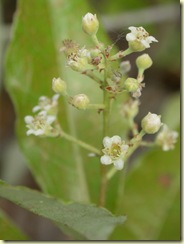
I leave with you the simple raceme of gopher apple (Licania michauxii). One of my favorite plants (aren’t they all). These petite blossoms will give way to a delicious ( to the peculiar palate) white egg shape fruit. The taste is some what reminiscent of the philodendron Monstera deliciosa and simultaneously of that of something overripe. A couple of fairly large patches of gopher apple are really putting on a show right now in the western sandhill. There should be lots of fruit for the gopher tortoise with maybe a few left over for me.

Happy weekend. Get outside!

Thursday, May 28, 2009

Pioneers in Space

DSCN7996

Part of the challenge in habitat restoration that entails clearing mechanically or with herbicide is just what will take advantage of all that new growing space. Often it is not the species you desire. Case in point; the ubiquitous Caesar weed (Urena lobata). This aggressive pioneer species has taken advantage of the recent cleaning and clearing around the outdoor stage complex.

DSCN7997

A vast carpet of paired cotyledons glow green from a thick compost of sand live oak leaf litter. I am amazed at the density of seedlings in this area. It makes me ponder dozens and dozens of children attentive to some program on the stage. Mindlessly they pluck away at the sticky burs caught in their clothing on their trip through the woods and drop them to fertile earth at their feet. There they lie in thick litter beneath a dense canopy, made denser by invasive vines, suppressed from growth. Then noble intentioned conservators armed with sharpened metal and the fruits of chemical ingenuity release vital elements of life, growing space. Then did mother nature let forth the final ingredient, a deluge of rain. It rained, they were sown, they conquered….time to break out the Round-Up.

Wednesday, March 11, 2009

One Man’s Weed

Lots of lovelies are peeking out some blossoms in the Back Woods. You may be familiar with some of these as common roadside weeds though they are shining here as welcome color in the woods. Here are just a few our spring early birds.

DSCN7394 Shiny lyonia (Lyonia lucida) or one of the many plants called fetterbush. Shiny lyonia is the Ericaceae family commonly known as the heath family. You will find blueberries and and St John’s wort in this family as well. Notice how the flowers are similar to blueberries. In a previous post we pointed out the notable lateral vein on the outside edge of the leaf. This shot captures both the flowers and that distinguishable characteristic.

DSCN7455 Florida greeneyes (Berlandiera subacaulis), a lovely little weed in the making it’s presence known in the sandhill.

DSCN7457 Some dew laden toadflax (Linaria canadensis) flowers. The family is a real mouthful…Scophulariaceae…gotta love it! Couldn’t you guess that common snapdragons are also found in this family. This diminutive flower is found in disturbed sites everywhere.

DSCN7464 One of Kristen’s favorites is about to explode across the Back Woods. Spiderwort (Tradescantia ohiensis) really can’t be beat for putting on a spring show. The flower color is sometimes hard to capture (blues and purple often do not photograph true) but, I think we came pretty close here.

Thursday, March 5, 2009

Beautiful Brambles

The highbush or sawtooth blackberries (Rubus argutus [syn. betulifolius]) are starting to show some color (a little early it seems) in the Back Woods. And, of course we all know what follows is a juicy aggregate of drupelets we call a berry. Yum! This particular blackberry species is found throughout the Southeast in wet or dry areas and is commonly found in disturbed areas. Blackberries of all species are a very important group of plants to wildlife. The fruit is eaten by mammals and birds, the foliage is browsed deer and rabbits, and the thickets are refuge and nesting sites to many kinds of animals.

Wednesday, October 15, 2008

Sandhill in Bloom

Now is a great time to check out the sandhill communities in the Back Woods at MOSI. Many beautiful sandhill and scrub wildflowers put on their show in the fall.


Blooming now are fragrant coastal plain palafox (Palafoxia integrifolia)
snowy clumps of sandhill wireweed (Polygonella robusta),

vivid spikes of blazing star (Liatris tenuifolia),

and the glowing rays of goldenaster (Chrysopsis scabrella),


Please remember to enjoy the flowers by admiring from a distance or keep the memory through photography but, please do not pick flowers or remove plants from the preserve. Wildflower watch critters are on duty!

Friday, September 12, 2008

Local Native Plant Guide


The English Creek Native Tree & Plant Tour guidebook featuring many of the most common trees and plants found in bottomland hardwood forests in our area of central Florida is now available online.


The guidebook contains color photographs of key identifying characteristics as well as details about the plants' uses, range, and habitat. This is a nice portable reference manual for the layman and professional alike.
~
A similar project is in the works for our little forest. We will have a guidebook to common plant species of the Back Woods as well as a self guided tree tour before the end of next year.