Showing posts with label wetland. Show all posts

Friday, May 7, 2010

Lizard’s Tail

DSCN1501_stitch

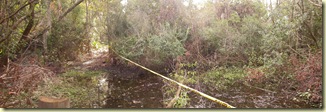
The new boardwalk allows visitors a closer look at more of the unique plants found in the wetland. Over the past couple of weeks the lizard’s tail (Saururus cernuus) has been working up to a dazzling show. Spreading by underground runners (rhizomes), nice sweeps of two feet deep glossy green foliage have developed and filled much of the wetland. The foliage is topped everywhere with drooping white spikes of flowers. Once the flowers are pollinated, the spike transforms to string of brown capsules that resembles a lizard’s tail. Even when not in bloom lizard’s tail is recognizable by its stalked heart or arrow shaped leaves with rounded lobes at the base.

Nifty etymology note: from the Greek sauros for lizard and from the Latin cernuus for falling down or nodding

Friday, December 18, 2009

Barred Owls and Boardwalks

DSCN0820 DSCN0837

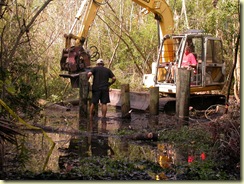
Construction of the new boardwalk got underway this week just in time for all the stormy weather. Posts from the previous boardwalk had to be removed before construction of the new walk could begin. The crew from Golf Construction seem to be having plenty of fun slogging about in the thick of it to get the job done.

DSCN0801 Rumbling through the Back Woods on the GATOR utility vehicle is not always the best way to catch sight of wildlife. Unless you are satisfied with glimpse of their rear ends dashing away from the awful rattle the gator makes. I startled this beautiful Barred Owl out of a tree as I rumbled under its perch along the trail. Fortunately for me, after swooping right over my head, this owl took a moment to catch a glimpse of me before silently flying off to some other spot in the canopy. What a cutie!! The Barred Owl should be right at home in our little forest, preferring a mature canopy and tolerant of urban areas. The habitat improvements we are making, including opening up the understory, should improve the habitat even more for the  Barred Owls.
DSCN0581 DSCN0834

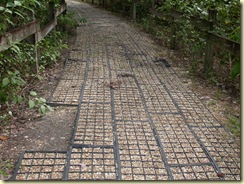
Oh boy, this Saturday December 19th is going to be some down and dirty fun. About a dozen intrepid volunteers have signed up to help us pull up the old plastic Geoblock underlayment from the nature trail. Fortunately for us, it looks like the rain will let up just in time for the work to start tomorrow morning. The chilly temperatures expected might just be perfect for the heavy load of the day, pulling up nearly a 1/3 mile of plastic panels all screwed together and full of  rock.   I am excited to see the trail with out the Geoblock which has been exposed and damaged for a number of years. The short experimental stretch that volunteer Shayna and I pulled up yesterday looks really good. If you are free we could always use a couple of extra hands. Volunteers are meeting in the far southeast parking lot of the museum at 7:45 am, see ya there!! :-)

Wednesday, December 2, 2009

Happening where its Wet in the Back Woods

DSCN0724_stitch DSCN0722_stitch

Design and permitting of the new boardwalk is moving right along. Once complete, the boardwalk will be part of a new main entrance to the Back Woods trails. It is planned to be 6ft wide with rails and a nice 10x16 observation deck about in the center where visitors can take a moment to view the plants and critters that make our wetlands home.  We anticipate the boardwalk will be completed by the end of December and of course we’ll keep you updated as the project progresses. In the meantime, there is much work to be done clearing invasive vines and overgrown hardwoods around the new proposed main entry and boardwalk entrance. Contact me directly if you are interested in volunteering to help us in the clearing!

DSCN0639 Couldn’t resist dropping in this shot of my favorite tree in the Back Woods. This plump bottle  bottom shaped tupelo (Nyssa sylvatica biflora) with its mossy base is such a stand out. This shot was from last week during our brief dry down otherwise this spot is definite waders or galoshes territory! One of our challenges is making some of these very interesting but frequently wet areas accessible without damage to the wetland and without muddying up the visitors. Not worried about getting your feet wet? Let me know and I’ll clue you in on the cool things to check out where it is wet in the Back Woods!

Tuesday, May 19, 2009

Welcome Rain

sinkhole wet II 5-14-09

I had been watching tensely as the dry days kept coming following our recent pine planting. I was cringing as the candles on the longleaf seedlings wilted in the heat. I was afraid we were going to lose significant numbers of trees. Fortunately, the recent rains have provided some much needed moisture and relief from the heat. Most of the pines are perky and happily soaking up every last drop the sky lets loose on them.

The wetlands are filled to capacity again and water is still overflowing Buttonbush pond to the sinkhole complex (pictured above). The frogs are in heaven. The cacophony of courting following the first really significant deluge was nearly deafening. I heard way too many non native Cuban tree frogs (Osteopilus septentrionalis) and a few greenhouse frogs (Eleutherodactylus planirostris) in the mix but, was pleased to hear competing choruses from southern toads (Bufo terrestris) and a few green tree frogs (Hyla cinerea). I really need to buff up on my frog calls to better determine the diversity our anuran residents. Check out the Frog Listening Network to beef up your own skills and take part in citizen science network of collecting data.

DSCN7950

Find out more about Florida frogs and toads at this UF Wildlife Extension page

Monday, May 11, 2009

Cypress Twig Gall Midge

DSCN7784

Insects fascinate me almost as much as plants. Their unique evolutionary ties with plants whether commensal, beneficial, or parasitic are a source of endless wonder to me. I share with you today, the cypress twig gall midge. I found these guys on the lower limbs of bald cypress in natural wetland when I was trying to find immature cypress cones low enough to photograph. You can just see (below) the top of the same tree loaded with ball shaped cones. If you don’t hear from me in a while it is probably because I fell out of a cypress trying to get a picture.

DSCN7783

Tuesday, April 21, 2009

Pleasant Surprise

DSCN0089 Retrieving a trash can lid tossed in the woods during the recent blow; I came across this little guy quite comfortable underneath. A first wild find for me, this is a pine woods snake Rhadinaea flavilata. Found in moist pinelands and hardwood wetlands (this one was in the wet Flatwoods near the sinkhole), they are common in central Florida. Smaller more isolated populations of this reptile, impacted by habitat destruction, are in imperiled status in other states. Although listed as non venomous, they are actually rear fanged and have what one site termed “slightly venomous saliva”. They are egg layers and the adults reach about 10-13 inches in length like the one pictured here. One more “made my day” moment courtesy the Back Woods.

Monday, April 6, 2009

Snapping Turtle Tease

Man am I a sucker for critters. There is not a one out there I cannot be induced to coo over (well except maybe Huntsman spiders). Here is my latest coo.

DSCN0026 This little snapping turtle (Chelydra serpentina serpentina) was making his or her way out of the stormwater retention to the wetland this morning. This is the time of year we might see aquatic turtles moving in and out of wetland areas to find mates.

DSCN0031 It may be a little early (but it seems like a lot of things are happening early this year) but this animal may have been moving out of the wetland looking for a nesting area to lay eggs.

A note on the photo quality. Sadly, my (personal) Nikon Coolpix 4500 has suffered some sort of malfunction. Borrowing a later generation coolpix from the museum exhibits department has been disappointing. Of course the question is…is it the user or the equipment…I’ll definitely take part of the blame in needing to get up to speed with a new camera but, the lens on this later model does not produce the color and clarity of my old 4500, sigh.

Monday, December 1, 2008

Invasive Treatments and Wetlands Revealed

A second round of spraying has just been completed in the Back Woods. You may still notice blue marker dye on treated plants like this camphor tree (Cinnamomum camphora) that has been both girdled with a chainsaw and treated with herbicide. More before and after pictures coming soon!


There is a little fall color developing on the tupelo, red maple, cypress, and sumac particularly around the wetlands.
If you are intrepid, the wetlands are mostly dry and have all kinds of interesting plants and structures to see like the hummock above found in the center of the central wetland.
Lizard's tail (Saururus cernuus), an aquatic herbaceous perennial, is still in bloom in the central wetland.
Bottle based swamp tupelo (Nyssa sylvatica var. biflora) stand sentinel in the winter light at the wetland edge. Lichen and moss lines on their trunks reveal the history of water levels in the central wetland.
Fetterbush (Lyonia lucida) grow in wet flatwoods but can also be found growing in the midst of the wetlands on hummock islands of roots and decaying vegetation. Even when not in bloom they can be readily identified by the very distinct vein that runs along the outside edge of the leaf blade.
(Lyonia lucida leaf closeup courtesy A.C. Moore Herbarium)
And last but, certainly not least, climbing aster (Symphyotrichum carolinianum) are making a show in the eastern wetland. You may also know this plant by its synonym Aster carolinianus. This woody vine is frequently found along riverbanks and swamp margins. Its lavender-pink flowers attract bees and butterflies alike. Should you come across some; it is easily started in your own garden from collected seed.