Showing posts with label gopher tortoise. Show all posts

Friday, January 22, 2010

New Trail Surface and More

DSCN0409_stitch

What a wonderfully frosty start to the new year. Much of the Back Woods vegetation is thoroughly dormant right now. The few Semi evergreen and evergreen trees and shrubs stand out starkly against the sleeping skeletons of deciduous trees. The warming weather has brought our gopher tortoises out foraging to make up for lost time in a torpor over the wintery past couple of weeks. We did catch a fine example of some mighty generous and frosty gopher tortoise poo deposited right before the freezes.

DSCN0410

Volunteers George, Shayna, and Catlin helped me finish pulling up the last of the plastic on the main trail in preparation for the new shell bed. Local contractor Scheid’s Tractor Service did an awesome job of laying out the shell and doing a finally grade by hand! Thanks Eddie, it looks great. The new trail really looks fabulous and feels great underfoot. It is definitely crunchy, as a couple of people noted, but that should evolve as the material breaks down under traffic. The new surface is now much safer surface for hikers of all abilities. Take a moment to peak your feet from time to time, there is some other fossiliferous material mixed in with shell. You might just find a sharks tooth or two if you have a keen eye.

DSCN0422

More on the Volunteer front: Great news for the Back Woods! Volunteer Catlin has begun an internship with us in conjunction with finishing an Environmental Science and Policy degree at USF. We are very happy to have her input and help as we complete the last of the requirements of our EPC grant and move on implementing a new grant from the US Fish and Wildlife Service rehabbing the uplands.

The past two weeks have been a doozies  for finding the weird in the Back Woods. A collection of the usual unusual as we continue to pick up and maintain the preserve.

Friday, December 11, 2009

Back Woods Happenings and Such

I am remiss in yet lauding the activities of our two new repeat volunteers. College students Shayna and Catlin joined us in October. Since that time, they have made a serious impact on invasive species with their weekly volunteer activities. The gals took the lead in clearing air potato by hand out of the bottoms west of the Buttonbush Pond. From there, they have been tackling the Caesar weed (Urena lobata) that sprang up en masse in the plow line cut to control the brush fire last spring. I can not thank these women enough for their dedicated efforts in the Back Woods.

We welcome back our volunteer George. Down for the winter, George brings his trail maintenance experience from working on access trails to the AT at his summer home. He is currently helping me break down all the cherries we are thinning out of the forest. George also volunteers for us on a weekly basis, we are very happy to have him back.

DSCN0716 Bones from above…last week while pulling air potato vines from the tree canopy, one of the volunteers was rewarded with bone dropped on her head. The bone looks like a large bird tibia. First thought was maybe it was from a bird that died in the tree top and the carcass never made it to the ground because of all the vines. A closer look at the bone shows it to be thoroughly gnawed on all over (nom, nom, nom as our Butterfly Guru would say.) It is possible a squirrel brought the bone up into the canopy to gnaw on for tooth maintenance or calcium.

DSCN0753 The western sandhill is home to at least 1 large adult and a couple juvenile gopher tortoises. The big guy ( I call him Fred) has nice burrow with a huge apron of sand right near the trail. This location is great for the education staff to show students the characteristics of a burrow fairly up close. This location also puts the tortoise at a little greater risk from visitors who are not familiar with the sensitive nature of the burrows or the threatened status of the tortoises. Recently, it appears a regular visitor likes to inspect the burrow up close and with a canine companion. We have now posted a sign asking visitors to maintain their distance. In the near future, we will have kiosks with rules for the Back Woods posted. One of those will be pets must be leashed and picked up after. Until that time, I guess we’ll have to rely on our resident pooper scoopers like this rainbow scarab (along with at least one other variety of dung beetle) made quick work of a pile o’ dog doo left in the sandhill.

DSCN0729 Awww! I am a serious sucker for ‘possums. Fortunately for me, they frequently find themselves trapped in the bottom of a trash can on the MOSI grounds. The staff must have me on speed dial for this situation because, I always get the call to help resolve the problem. My solution: Trek the can, possum in tow, to a spot off trail in the Back Woods. Most of the time the possum is in such a defensive stupor they won’t even make a run for it when I lay the can over. This little lady however skipped right out of the can the moment I laid it down and quite calmly sauntered off into the brush. Take a close look at the pickin’s in that trash can. What respectable Opossum could pass that up? Find one in your can at home? Just lay the can over and leave it be for awhile and the possum will find its way out on its own. Secure your can lids to prevent the problem in the future. :-)

Possibly to become a weekly tradition is a post featuring the the endless supply of air potatoes and more unusual or interesting trash collected during our work in the Back Woods. I humbly bring you this week’s Taters and Trash.

DSCN0795 DSCN0797Out of a pile of air potatoes picked up up while clearing Caesar weed, this one was definitely worth highlighting. With a little imagination it definitely looks cartoonish even reminiscent of a Bill Plympton caricature. The trash seems to be everywhere you look some days. A closer inspection finds all kinds of household garbage and construction debris as well as automotive junk. The plastic horse head, slightly surreal without its stick, is our find of the week. DSCN0799

Friday, November 13, 2009

Paw Paw Petals

DSCN0551 

Missing from our suite of species in the Back Woods is the Florida native dwarf paw paw, Asimina pygmea. Fortunately, they are found nearby on the westernmost undeveloped portion of the museum’s property. I captured a nice cluster of plants in bloom last week to share with our readers.

The flowers start out white then develop into a beautiful deep maroon color and are sometimes candy striped in between. The flowers are pendant along the stems developing at the leaf axis. The flowers are followed by an oblong edible yellowy green berry. Another common name for this species, gopher berry, may indicate that gopher tortoise make these an addition to their grassy diet. The larvae of Zebra Swallowtail butterfly feed on the foliage of many Asimina spp. as well.

Plans are to capture the fruit and seed of these plants to cultivate and transplant them to the flatwoods areas of the Back Woods. That is if the Med Flys don’t beat us to them ;-)

DSCN0535

Friday, June 12, 2009

Another Day in the Woods

I just knew today was going to be a little absurd. You know the feeling… you are sure everything is going to be slightly askew. With that thought in mind, a grin on my face, and loppers in hand I headed for the woods. My heart sank in the sandhill when I saw what appeared to be one of the larger adult gopher tortoise dead in the mouth of a burrow a little too small for it. The burrow was collapsed at the top and the apron and surrounding bare sand held imprints of dog paws. Reaching in to the burrow to retrieve the body I was treated to a hiss and flip of sand by a still kicking tortoise. Fortunately our little guy had survived but was obviously exhausted by the ordeal of escaping from a domestic dog and still with back to wall per se wedged in a too small burrow. I left it be and happy to find it recovered later in the day. Dealing with free roaming domestic animals, other feral non native animals, and even some native predator species are some of the greatest challenges to maintaining a natural area for native wildlife in urban areas. Gopher tortoises are susceptible to predation from dogs, cats, armadillo, opossum, and raccoons. All of these animals are known to predate juvenile tortoise and eggs while dogs pose the greatest threat to adult tortoise. Forgive me if I am repetitive in the message of being a responsible pet owner. Please do not allow your domestic animals to roam free. Most of the animals we consider as pets are predators and no matter how well fed will prey on any native wildlife they come upon. Never release unwanted pets in the wild. Domestic pets dumped in the wild are subject to injury and death from other animals and disease. Of course spay and neuter to prevent reproduction should your pet get out or get away. Preaching done, thanks.

DSCN8150 How is it that a plant this pretty is such a pain in the back side?! My perpetual nemesis the air potato (Dioscorea bulbifera) is on the come back after the treatments of last fall and spring. This PDF on Air Potato Management in Florida tells you all you need to know and more about air potato. Should you happen to feel the need to enact your own form of vengeance on this pernicious example of flora; I would welcome any assistance in maintaining control of this green monster in the Back Woods. Potential attacks could come in the form of air potato pick ups, hand pulling vines, or machete meets vine action and I’ll bring up the rear with the herbicides. In the process, you will hopefully come across a few examples of the resident wildlife, flowering native plants, and donate a few thimbles of blood to the mosquito population. Possibly you might find an interesting artifact or two.

DSCN8154 What an odd little find. This strange little “bird” figurine almost looked like a mummified bird body when I first came across it in the leaf litter. A closer look around revealed several other old plastic toys and children’s items long ago discarded in another one of the Back Woods’ remnant trash heaps. All of this was beneath a very nifty toppled laurel oak (Quercus laurifolia), with a 10 foot diameter pancake of upturned root system, still happily growing horizontally.

DSCN8156 Also beneath the oak was a smattering of Virginia chain fern (Woodwardia virginica) and even a clump of royal fern (Osmunda regalis). I really need to buff up on my ferns again. It’s all about venation and where the sori are! (LOL) A nice online key to ferns in southwest Florida can be found on the Audubon Corkscrew Swamp Sanctuary website.

DSCN8159 (plant nerd alert) And then I looked up to see a sprig of inequilaterally based, doubly serrate margined, distinctly parallel veined leaves and shouted to the sky, “It’s an elm!” To the west of the sinkhole complex there are several long dead snags of American elms (Ulmus americana) (now charred from the brush fire) but I have not come across a single live American elm anywhere on the property. Now, low and behold, one skinny little sapling was arching its way out of the weedy brush towards the light right in front of me. It had taken advantage of growing space provided by the falling of that big laurel oak mentioned earlier and was holding its own against the smother of elderberry and wax myrtle (Morella cerifera). Yay, new tree species to add to diversity of the site.
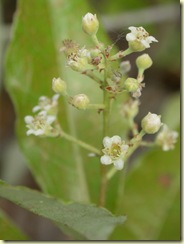
DSCN8147

I leave with you the simple raceme of gopher apple (Licania michauxii). One of my favorite plants (aren’t they all). These petite blossoms will give way to a delicious ( to the peculiar palate) white egg shape fruit. The taste is some what reminiscent of the philodendron Monstera deliciosa and simultaneously of that of something overripe. A couple of fairly large patches of gopher apple are really putting on a show right now in the western sandhill. There should be lots of fruit for the gopher tortoise with maybe a few left over for me.

Happy weekend. Get outside!

Thursday, April 16, 2009

More Gopher Goodness

Couple more shots from my guests from the EPC.

DSCF1510 DSCF1511

Looks like hatchling size to me but, seems a little out place in that much of the literature indicates breeding season starting around April with up to a 100 day gestation. So, we’ll assume he is probably last years brood going on 6-9 months old. Our resident ecologist Celina has them on her radar now. Won’t be long and I am sure she’ll be giving us a full rundown as soon she comes across one!

MOSI’s Newest Team Member

While touring with some guests from the EPC through the Back Woods this morning, we came upon (and nearly stepped on) on this super coo inducing little cutie. There might not be anything cuter in a sandhill than an itty bitty orange gopher tortoise baby. And, along with the news that a staff member relocated another the same size from the parking lots earlier in the week; I would say we have good evidence there is a reproducing population of gopher tortoise using the sandhills in the Back Woods! Yay!

IMAGE_267

And to put that size in a little better perspective…

IMAGE_268

Wednesday, March 11, 2009

Scat Alert

One man’s scat is this foresters smile of the day. I present to you; gopher tortoise poo.

DSCN7453

Tuesday, March 10, 2009

Sandhill Expansion

Saturday was an absolutely wonderful day spent with old friends and new. Members of the Caribbean Chapter (all of central to southern Florida and Puerto Rico) of the Society of American Foresters held their annual volunteer service day in the Back Woods @ MOSI. New volunteer Forest Stewards, George and Brian, joined us to learn some chainsaw skills and help in the cleanup.

IMG_6124Priority of the day was to tackle the hardwoods (mostly sand live oak [Quercus geminata] and some black cherry [Prunus serotina] that are encroaching on the sandhill plant community. Commonly the canopy of trees in a sandhill community in our area might be dominated with longleaf pine (Pinus palustris) with a mix of a little turkey oak (Quercus laevis) , bluejack oak (Quercus incana), sand live oak, and others depending on the amount of disturbance (fire) the system is exposed to. Typically these systems are very open and subject to frequent low intensity fires that keep all but the fire resistant longleaf pine from dominating the canopy.

IMG_6116 Needless to say their were some hardwoods shaking in their roots on Saturday. To the task; professional foresters (Sam), land managers (Stu), forestry consultants (Eric), and forestry students (Walter) broke out their chainsaws and starting clearing. Many thanks to SAF member Sam for sharing chainsaw skills with our volunteer Brian (we might even make him a forester). Some serious progress was made in the western sandhill. Unwanted hardwoods were cleared in the center and around the perimeter. This section is one of the few open areas in the forest still able to support  herbaceous sandhill species and gopher tortoise.

IMG_6117 In addition to clearing trees, we cleared a serious amount of garbage from the sandhill. Volunteer George meticulously collected bags and bags of broken glass, mattress coils, and miscellaneous construction debris buried in the sandhill and more  revealed by the clearing activities. There is still a disturbing amount of buried material throughout the forest but with our volunteers concerted efforts, the task is most definitely surmountable!

IMG_6134 SAF members Mindy and Erin took on the task of recording GPS coordinates and conditions of the over 100 trees planted in January for MOSI’s Florida Arbor Day Celebration. Fortunately both Mindy and Erin participated in the January plantings and were familiar with the scattered locations of all the trees. Following the field collection, Mindy is collating all the data and producing GIS documents to analyze the data spatially(Thanks Mindy!). With this data, we hope to track the success of the planting and the future growth of the trees.

IMG_6143 We closed out the day hot and dusty. I thanked my friends for all their help and wished them well on their way home (some traveled over a hundred miles to join us for the day). I captured one last photo in the woods as everyone left. A honey bee on poison ivy (Toxicodendron radicans) blossoms signaling to me Spring is on the way and all is well with the woods.

Tuesday, September 2, 2008

Sandhill Show N Tell

Today, I was treated to a multitude of six-lined racerunners (Cnemidophorus sexlineatus sexlineatus) scurrying about in the sandhill. Every step I took sent zippy little teeids scurrying in every direction (they are supposedly capable of running up to 18mph). Amazingly, one allowed me to get close enough to snap a couple of photos.

One of our western sandhill residents... gopher tortoise (Gopherus polyphemus)...I call him Fred.


A little ceraunus blue (Hemiargus ceraunus) butterfly atop narrowleaf silkgrass (Pityopsis graminifolia).

Florida harvester ants (Pogonomyrmex badius)... I love how they usually adorn the perimeter of the mound with charcoal.