I just knew today was going to be a little absurd. You know the feeling… you are sure everything is going to be slightly askew. With that thought in mind, a grin on my face, and loppers in hand I headed for the woods. My heart sank in the sandhill when I saw what appeared to be one of the larger adult gopher tortoise dead in the mouth of a burrow a little too small for it. The burrow was collapsed at the top and the apron and surrounding bare sand held imprints of dog paws. Reaching in to the burrow to retrieve the body I was treated to a hiss and flip of sand by a still kicking tortoise. Fortunately our little guy had survived but was obviously exhausted by the ordeal of escaping from a domestic dog and still with back to wall per se wedged in a too small burrow. I left it be and happy to find it recovered later in the day. Dealing with free roaming domestic animals, other feral non native animals, and even some native predator species are some of the greatest challenges to maintaining a natural area for native wildlife in urban areas. Gopher tortoises are susceptible to predation from dogs, cats, armadillo, opossum, and raccoons. All of these animals are known to predate juvenile tortoise and eggs while dogs pose the greatest threat to adult tortoise. Forgive me if I am repetitive in the message of being a responsible pet owner. Please do not allow your domestic animals to roam free. Most of the animals we consider as pets are predators and no matter how well fed will prey on any native wildlife they come upon. Never release unwanted pets in the wild. Domestic pets dumped in the wild are subject to injury and death from other animals and disease. Of course spay and neuter to prevent reproduction should your pet get out or get away. Preaching done, thanks.
 How is it that a plant this pretty is such a pain in the back side?! My perpetual nemesis the air potato (Dioscorea bulbifera) is on the come back after the treatments of last fall and spring. This PDF on Air Potato Management in Florida tells you all you need to know and more about air potato. Should you happen to feel the need to enact your own form of vengeance on this pernicious example of flora; I would welcome any assistance in maintaining control of this green monster in the Back Woods. Potential attacks could come in the form of air potato pick ups, hand pulling vines, or machete meets vine action and I’ll bring up the rear with the herbicides. In the process, you will hopefully come across a few examples of the resident wildlife, flowering native plants, and donate a few thimbles of blood to the mosquito population. Possibly you might find an interesting artifact or two.
 What an odd little find. This strange little “bird” figurine almost looked like a mummified bird body when I first came across it in the leaf litter. A closer look around revealed several other old plastic toys and children’s items long ago discarded in another one of the Back Woods’ remnant trash heaps. All of this was beneath a very nifty toppled laurel oak (Quercus laurifolia), with a 10 foot diameter pancake of upturned root system, still happily growing horizontally.
 Also beneath the oak was a smattering of Virginia chain fern (Woodwardia virginica) and even a clump of royal fern (Osmunda regalis). I really need to buff up on my ferns again. It’s all about venation and where the sori are! (LOL) A nice online key to ferns in southwest Florida can be found on the Audubon Corkscrew Swamp Sanctuary website.
 (plant nerd alert) And then I looked up to see a sprig of inequilaterally based, doubly serrate margined, distinctly parallel veined leaves and shouted to the sky, “It’s an elm!” To the west of the sinkhole complex there are several long dead snags of American elms (Ulmus americana) (now charred from the brush fire) but I have not come across a single live American elm anywhere on the property. Now, low and behold, one skinny little sapling was arching its way out of the weedy brush towards the light right in front of me. It had taken advantage of growing space provided by the falling of that big laurel oak mentioned earlier and was holding its own against the smother of elderberry and wax myrtle (Morella cerifera). Yay, new tree species to add to diversity of the site.
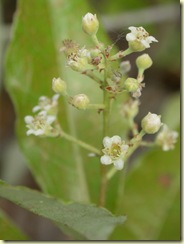
I leave with you the simple raceme of gopher apple (Licania michauxii). One of my favorite plants (aren’t they all). These petite blossoms will give way to a delicious ( to the peculiar palate) white egg shape fruit. The taste is some what reminiscent of the philodendron Monstera deliciosa and simultaneously of that of something overripe. A couple of fairly large patches of gopher apple are really putting on a show right now in the western sandhill. There should be lots of fruit for the gopher tortoise with maybe a few left over for me.
Happy weekend. Get outside!


