Showing posts with label wildlife. Show all posts

Friday, August 6, 2010

Bugs Abound

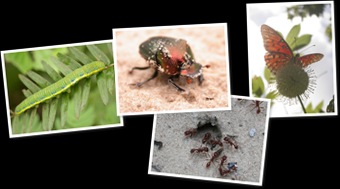
Bugs abound in the Back Woods this summer! If you are a fan of most things Arthropoda, you might want to spend and afternoon hitting the trails, scouring the foliage, and sifting through the leaf litter in the Back Woods.

Nectaring butterflies have been the hot commodity at the Buttonbush Pond during the spring/summer bloom. The egg laying action is about to pick up in the sandhill where the partridge pea (Chamaecrista fasciculata) will prove irresistible to a variety of sulphur butterflies. The sandhill is where you will also find our very own example of Sisyphus in the rainbow scarab (Phanaeus vindex) diligently rolling up and and storing whatever piles of poo it comes across. Florida harvester ants (Pogonomyrmex badius), forever on the march, find their home in the sandhill as well.

The cicadas are most definitely turning up the volume through out the woods…look for their molts at the top of shrubs and dead  branches. Keep your focus ahead on the trails lest you walk right into the web of a tiny spiny orb weaver (Gasteracantha cancriformis) or a not so tiny golden silk spider (Nephila clavipes). One of my favorites, the green lynx spider (Peucetia viridans), looks like green glass. They don't spin a web but rather stalk the foliage for their unsuspecting prey.

Deep in the leaf litter you will likely come across all sorts of things including the real Florida palmetto bug…the Florida woods cockroach (Eurycotis floridana). These nearly wingless roaches are not considered household pests preferring the rich bounty of the outdoors to your pantry. Disturb them and they emit a very noticeable odor something like almonds or sweet amaretto.

Once you have had your buggy fill of the Back Woods don’t forget to stop off in the Bioworks Butterfly Garden for an up close look at the metamorphosis of Florida native butterflies.

Of course, the woods would not be the woods without our very own population of mosquitoes. So, use good sense as you would in any outdoor area this time of year, cover up and wear your insect repellant.

DSCN8581

Check out the Animal Species tab at the top of the page for a listing of more of the insects found in the Back Woods

Friday, May 14, 2010

Red Ratsnake

DSCN1513We were delighted to see this little red ratsnake warming up on the new trail surface last week. We can now happily add this critter to our list of species present in the Back Woods. Local University of Florida herpetology expert Monica McGarrity has been gracious enough to write a guest post for us on the red ratsnake. Definitely, do not miss reading the excellent guide Dealing with Snakes in Florida’s Residential Areas: Identifying Commonly Encountered Snakes co written by Monica and linked below as well.

Note, there has been a recent change in the taxonomic classification of the red ratsnake…you may find many publications still refer to it as Elaphe guttata.

Guest Blogger: Monica E. McGarrity, Biological Scientist : Gulf Coast Research & Education Center/University of Florida/IFAS

Like the name suggests, Red Ratsnakes belong to the ratsnake genus Pantherophis—their scientific name is Pantherophis guttatus. Florida’s farmers have historically welcomed these non-venomous snakes to their farms, because they provide outstanding rodent control. In fact, Red Ratsnakes are more commonly called Cornsnakes because they liked to hang around in the rafters of old corn storage “cribs” and eat the mice and rats that tried to get into (and eat) the corn. All ratsnakes are excellent climbers—they can climb nearly straight up a tree or a brick wall! Their bodies aren’t quite round like the bodies of most snakes, but are shaped more like a loaf of bread in cross-section. The wide scales on their flat bellies work a lot like the treads on a tank, helping them to grip bark and climb trees more easily. These efficient predators can be found virtually anywhere there is rodent prey afoot—in citrus groves, sheds, garages, and even attics! Although you should welcome these natural exterminators in your yard, you may want to snake-proof the vents on your roof and control rodents in your attic or garage unless you don’t mind having them in your house as well.

09/15/09 Red Rat Snake or Corn Snake reptile Cornsnake pattern_McGarrity Cornsnakes are beautiful animals, and are very popular in the pet trade because they can be bred in a various hues of red, yellow, orange, pink, or even cream. In nature, their tan to grayish bodies are marked with orange-red blotches with dark outlines. Their heads are marked with a distinctive orange-red arrowhead, with a series of light and dark blotches inside. The markings on the belly are most distinctive of all—a black and white checkerboard pattern! You may encounter these snakes crossing trails or sunning themselves on logs or trees in natural areas, so you should learn to recognize these Florida natives.  

 DSCN1515

Dealing with Snakes in Florida’s Residential Areas: Identifying Commonly Encountered Snakes -- http://edis.ifas.ufl.edu/uw258

Florida Museum of Natural History Herpetology Department – Red Cornsnake -- http://www.flmnh.ufl.edu/herpetology/fl-guide/pantherophisguttatus.htm

Thank you Monica!!!

Nifty etymology note: “Pantherophis is derived from the Greek words"pan" which means bread, referring to the bread loaf, cross-section shape of the snake, "thero" means a wild beast of summer and "ophis" means snake and guttatus is derived from the Latin word gutta which means "dappled" or "spotted" referring to the dorsal pattern.” courtesy Virginia Herpetological Society

Wednesday, April 28, 2010

Leaflets of Three, Leave Them Be

DSCN1260 And of who else might we be speaking of but… none other than the much maligned poison ivy vine. Poison ivy (Toxicodendron radicans) is in the sumac (cashew) family Anacardiaceae. Other notable South Eastern relatives of poison ivy include Eastern poison oak (T.pubescens), poison sumac (T. vernix), winged sumac (Rhus copallina), and one of our least favorite plants the non native invasive species Brazilian pepper (Schinus terebinthifolius). I have not found poison sumac very prevalent in our area and poison oak seems to be restricted more to northern Florida by all accounts. If you have come across either in our area, I would love to know. (note that all of the plants mentioned above may cause a skin rash if you come in contact with them, depending on your sensitivities)

I think the old saying went something like “leaves of three, leave them be” where actually it should say “leaflets of three”. Instead of three leaves,  you are actually looking at one leaf with three leaflets. But if it helps you to remember, we’ll leave that be as well. Poison ivy contains an irritating oil called urushiol. Contact with this oil that comes from all parts of the poison ivy plant may cause dermatitis (sometimes extreme) in some people. The American Academy of Dermatology recommends washing any exposed areas with soap and water as soon as possible after contact to remove the oil as well as promptly laundering any contaminated clothing. Over the counter medications to relieve the itching and patience are the only treatment for the rash that may last more than a couple of weeks. Of course, see a doctor for severe exposures.

Avoiding contact with poison ivy is your first defense. There are otc products available to apply to exposed skin to prevent contact with the urushiol oil. Be mindful that you can also come in contact with the oils of poison ivy from your clothing or pets exposed to the plant. Take special precautions when mowing or weed eating poison ivy as the oil can can be sprayed everywhere from the cutting action. Burning poison ivy may volatize the oils allowing them to be inhaled, not good.

Knowing your enemy: Poison ivy is a deciduous vine (meaning they lose their leaves in the winter) whose alternate leaves have three unlobed or slightly lobed leaflets each. Very pretty clusters of fragrant white flowers (very attractive to bees) are followed by white/tannish drupes in the spring around May. In the fall, the leaves turn bright red before falling from the plant. When the plants are leafless the stems, attached to trees or other surfaces, are still easily recognized by their dense aerial  roots that gives them a hairy appearance. Their hairy appearance readily distinguishes them from grape vines with no aerial roots or Virginia creeper vines that have sparse rootlets with five little pads at the end.

 leaf of poison ivy with three leaflets (on left) by the similar non toxic Virginian creeper (Parthenocissus quinquefolia) with five leaflets leaf of poison ivy with three leaflets (on left) by the similar non toxic Virginia creeper (Parthenocissus quinquefolia) with five leaflets

woody stems of poison ivy covered in aerial roots woody stems of poison ivy covered in aerial roots

Nothing evolves to be just  a menace or nuisance so, what value is there in poison ivy you might ask? Well, countless numbers of songbirds are known to dine on the berries through out the plants range. Some of those sighted in Back Woods know to partake in a poison ivy berry or two include: Gray Catbird, Northern Flicker, Eastern Phoebe, Brown Thrasher, Tufted Titmouse, Cedar Waxwing, Carolina Wren, and Woodpeckers (Downy, Pileated, and Red-bellied). Additionally, bees love the flowers and deer browse on the foliage. Yay, poison ivy!

There are many web pages dedicated to poison ivy just a search engine away. One comes complete with slightly gruesome collection of photos called the “Skin Rash Hall of Fame”, ewww! You will find there great incentive to know your poison ivy and take the right steps to avoid exposure. As someone I love always reminds me, everything bites…so, get outside!!

Wednesday, March 11, 2009

Owl Remnants

DSCN7399 DSCN7400

Sadly one of our forest sentinels is silently composting in the Back Woods. I am not completely positive of the identification. I am pretty sure it is either a barred owl or a great horned owl, both of which have been documented using the Back Woods. Any birders out there who could confirm the id? Sigh.