Showing posts with label insects. Show all posts

Friday, August 6, 2010

Bugs Abound

Bugs abound in the Back Woods this summer! If you are a fan of most things Arthropoda, you might want to spend and afternoon hitting the trails, scouring the foliage, and sifting through the leaf litter in the Back Woods.

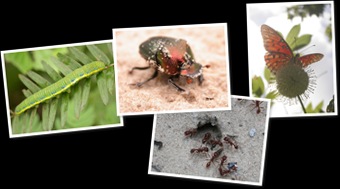
Nectaring butterflies have been the hot commodity at the Buttonbush Pond during the spring/summer bloom. The egg laying action is about to pick up in the sandhill where the partridge pea (Chamaecrista fasciculata) will prove irresistible to a variety of sulphur butterflies. The sandhill is where you will also find our very own example of Sisyphus in the rainbow scarab (Phanaeus vindex) diligently rolling up and and storing whatever piles of poo it comes across. Florida harvester ants (Pogonomyrmex badius), forever on the march, find their home in the sandhill as well.

The cicadas are most definitely turning up the volume through out the woods…look for their molts at the top of shrubs and dead  branches. Keep your focus ahead on the trails lest you walk right into the web of a tiny spiny orb weaver (Gasteracantha cancriformis) or a not so tiny golden silk spider (Nephila clavipes). One of my favorites, the green lynx spider (Peucetia viridans), looks like green glass. They don't spin a web but rather stalk the foliage for their unsuspecting prey.

Deep in the leaf litter you will likely come across all sorts of things including the real Florida palmetto bug…the Florida woods cockroach (Eurycotis floridana). These nearly wingless roaches are not considered household pests preferring the rich bounty of the outdoors to your pantry. Disturb them and they emit a very noticeable odor something like almonds or sweet amaretto.

Once you have had your buggy fill of the Back Woods don’t forget to stop off in the Bioworks Butterfly Garden for an up close look at the metamorphosis of Florida native butterflies.

Of course, the woods would not be the woods without our very own population of mosquitoes. So, use good sense as you would in any outdoor area this time of year, cover up and wear your insect repellant.

DSCN8581

Check out the Animal Species tab at the top of the page for a listing of more of the insects found in the Back Woods

Friday, December 11, 2009

Back Woods Happenings and Such

I am remiss in yet lauding the activities of our two new repeat volunteers. College students Shayna and Catlin joined us in October. Since that time, they have made a serious impact on invasive species with their weekly volunteer activities. The gals took the lead in clearing air potato by hand out of the bottoms west of the Buttonbush Pond. From there, they have been tackling the Caesar weed (Urena lobata) that sprang up en masse in the plow line cut to control the brush fire last spring. I can not thank these women enough for their dedicated efforts in the Back Woods.

We welcome back our volunteer George. Down for the winter, George brings his trail maintenance experience from working on access trails to the AT at his summer home. He is currently helping me break down all the cherries we are thinning out of the forest. George also volunteers for us on a weekly basis, we are very happy to have him back.

DSCN0716 Bones from above…last week while pulling air potato vines from the tree canopy, one of the volunteers was rewarded with bone dropped on her head. The bone looks like a large bird tibia. First thought was maybe it was from a bird that died in the tree top and the carcass never made it to the ground because of all the vines. A closer look at the bone shows it to be thoroughly gnawed on all over (nom, nom, nom as our Butterfly Guru would say.) It is possible a squirrel brought the bone up into the canopy to gnaw on for tooth maintenance or calcium.

DSCN0753 The western sandhill is home to at least 1 large adult and a couple juvenile gopher tortoises. The big guy ( I call him Fred) has nice burrow with a huge apron of sand right near the trail. This location is great for the education staff to show students the characteristics of a burrow fairly up close. This location also puts the tortoise at a little greater risk from visitors who are not familiar with the sensitive nature of the burrows or the threatened status of the tortoises. Recently, it appears a regular visitor likes to inspect the burrow up close and with a canine companion. We have now posted a sign asking visitors to maintain their distance. In the near future, we will have kiosks with rules for the Back Woods posted. One of those will be pets must be leashed and picked up after. Until that time, I guess we’ll have to rely on our resident pooper scoopers like this rainbow scarab (along with at least one other variety of dung beetle) made quick work of a pile o’ dog doo left in the sandhill.

DSCN0729 Awww! I am a serious sucker for ‘possums. Fortunately for me, they frequently find themselves trapped in the bottom of a trash can on the MOSI grounds. The staff must have me on speed dial for this situation because, I always get the call to help resolve the problem. My solution: Trek the can, possum in tow, to a spot off trail in the Back Woods. Most of the time the possum is in such a defensive stupor they won’t even make a run for it when I lay the can over. This little lady however skipped right out of the can the moment I laid it down and quite calmly sauntered off into the brush. Take a close look at the pickin’s in that trash can. What respectable Opossum could pass that up? Find one in your can at home? Just lay the can over and leave it be for awhile and the possum will find its way out on its own. Secure your can lids to prevent the problem in the future. :-)

Possibly to become a weekly tradition is a post featuring the the endless supply of air potatoes and more unusual or interesting trash collected during our work in the Back Woods. I humbly bring you this week’s Taters and Trash.

DSCN0795 DSCN0797Out of a pile of air potatoes picked up up while clearing Caesar weed, this one was definitely worth highlighting. With a little imagination it definitely looks cartoonish even reminiscent of a Bill Plympton caricature. The trash seems to be everywhere you look some days. A closer inspection finds all kinds of household garbage and construction debris as well as automotive junk. The plastic horse head, slightly surreal without its stick, is our find of the week. DSCN0799

Monday, October 12, 2009

Song of the Cicada

DSCN0021

The cast nymphal skeleton of a cicada clasped tightly to a branch of silkgrass (Pityopsis graminifolia). After four years underground and four molts, this was the last nymphal instar of the cicada. From this molt they emerge the winged adults that fill the summer nights with song.

If you are originally from up ‘north a ways’ you may remember the cicadas of your childhood summers varying from year to year. Northeastern populations of some cicada species are periodical and may appear in mass numbers in 13 to 17 year cycles. In Florida, populations of adults are produced every year.

Cicadas nymphs and adults both feed on plant fluids but neither is considered a serious pest in Florida. On the the other hand, adult cicada are considered good eating by numerous wildlife and are considered a notable survival food for humans as well. Hmmmm.

A nice time lapse video of a cicada molting from last instar to adult


Tuesday, September 1, 2009

Plant Profile: Partridge pea

Common Name: partridge pea, sleeping plant

Scientific Name: Chamaecrista fasciculata (Michx.) Greene

Form:  Annual legume (bean)

Height/Spread: 1-3 ft tall, spread similar to height.

Leaves: Alternate, evenly pinnately compound olive green leaves with small (up to 2cm) spine tipped leaflets. Leaflets fold along the rachis when touched or in response to nightfall. Two permanent stipules and a small disc shaped extra floral nectary gland are at the base of each petiole.

DSCN9008 DSCN9005

Stems: Smooth and green becoming reddish brown more haired with maturity.

DSCN9004
Flowers: Bright yellow 5 petaled flowers with red markings at the base of the petal. Stamens are sometimes red in color. One petal often folds in over stamen and anther. Flowers arise from leaf axil with the stem.

DSCN9003DSCN9002 

Fruit and Seeds: Flat 2-3 inch long legume (bean pod) producing dark brown flattened seeds.

DSCN9270

Habitat: Partridge pea is characteristic of dry upland plant communities. Can be found along the edges of disturbed sites.

DSCN9246_stitch

Range: Throughout the Eastern and Central United States.

Shade Tolerance: Somewhat tolerant.

Fire Tolerance: Habitat and establishment may be improved through fire.

Wildlife Use: Partridge pea is important as the larval host plant of several sulphur butterflies (Giant Cloudless, Little yellow, and Orange Sulphurs). (Check out Kristen’s Butterfly blog Lepcurious for a post on other host plants for sulphur butterflies) Seeds of partridge pea are important part of the diet of quail particularly in the Midwest. The plant as a whole is preferred white tailed deer browse.

DSCN9323 DSCN9314 Cloudless Sulphur larvae

Field ID: Partridge peas are in bloom throughout the summer months and are easily recognized by their bright yellow flowers and small pinnate foliage.

Information: Previously known as Cassia fasciculata, Chamaecrista fasciculata is a nitrogen fixing legume. It is commonly planted for soil stabilization and improvement projects. The small nectar gland at the base of each leaf attracts ant species which may in turn protect the plant from herbivores and plant damaging insects. Partridge pea has a long history in Native American culture as a medicinal plant but; partridge pea can be a purgative in humans and is toxic to livestock. So once again, let’s leave this one for the birds, bees, and butterflies.

References and Additional Resources:

  • Austin, Daniel F. Florida Ethnobotany. Boca Raton: CRC Press. 2004
  • Miller, James H., and Karl V. Miller. Forest Plants of the Southeast and Their Wildlife Uses. Athens and London: University of Georgia Press. 2005
  • Taylor, Walter K. The Guide to Florida Wildflowers. Dallas: Taylor Publishing Company. 1992
  • NPIN Native Plant Database Chamaecrista fasciculata
  • Illinois Wild Flowers Chamaecrista fasciculata
  • USDA Plants Profile Chamaecrista fasciculata

Monday, May 11, 2009

Cypress Twig Gall Midge

DSCN7784

Insects fascinate me almost as much as plants. Their unique evolutionary ties with plants whether commensal, beneficial, or parasitic are a source of endless wonder to me. I share with you today, the cypress twig gall midge. I found these guys on the lower limbs of bald cypress in natural wetland when I was trying to find immature cypress cones low enough to photograph. You can just see (below) the top of the same tree loaded with ball shaped cones. If you don’t hear from me in a while it is probably because I fell out of a cypress trying to get a picture.

DSCN7783

Wednesday, October 15, 2008

Sandhill in Bloom

Now is a great time to check out the sandhill communities in the Back Woods at MOSI. Many beautiful sandhill and scrub wildflowers put on their show in the fall.


Blooming now are fragrant coastal plain palafox (Palafoxia integrifolia)
snowy clumps of sandhill wireweed (Polygonella robusta),

vivid spikes of blazing star (Liatris tenuifolia),

and the glowing rays of goldenaster (Chrysopsis scabrella),


Please remember to enjoy the flowers by admiring from a distance or keep the memory through photography but, please do not pick flowers or remove plants from the preserve. Wildflower watch critters are on duty!

Tuesday, September 2, 2008

Sandhill Show N Tell

Today, I was treated to a multitude of six-lined racerunners (Cnemidophorus sexlineatus sexlineatus) scurrying about in the sandhill. Every step I took sent zippy little teeids scurrying in every direction (they are supposedly capable of running up to 18mph). Amazingly, one allowed me to get close enough to snap a couple of photos.

One of our western sandhill residents... gopher tortoise (Gopherus polyphemus)...I call him Fred.


A little ceraunus blue (Hemiargus ceraunus) butterfly atop narrowleaf silkgrass (Pityopsis graminifolia).

Florida harvester ants (Pogonomyrmex badius)... I love how they usually adorn the perimeter of the mound with charcoal.