Monday, October 12, 2009

Song of the Cicada

DSCN0021

The cast nymphal skeleton of a cicada clasped tightly to a branch of silkgrass (Pityopsis graminifolia). After four years underground and four molts, this was the last nymphal instar of the cicada. From this molt they emerge the winged adults that fill the summer nights with song.

If you are originally from up ‘north a ways’ you may remember the cicadas of your childhood summers varying from year to year. Northeastern populations of some cicada species are periodical and may appear in mass numbers in 13 to 17 year cycles. In Florida, populations of adults are produced every year.

Cicadas nymphs and adults both feed on plant fluids but neither is considered a serious pest in Florida. On the the other hand, adult cicada are considered good eating by numerous wildlife and are considered a notable survival food for humans as well. Hmmmm.

A nice time lapse video of a cicada molting from last instar to adult


Friday, October 9, 2009

Coastalplain Palafox

DSCN5414

The sandhill is putting on its annual fall show. Puffs of pale pink coastalplain palafox (Palafoxia integrifolia) dot the white sands in between lavender spires of blazing star (Liatris sp.). The palafox has a sweet fragrance and beetles of all kinds just seem to love it. Somewhat non descript much of the year, this pastel beauty is common in dry pinelands throughout Florida and most obvious during the fall bloom.

DSCN0005 DSCN0006

Wednesday, September 16, 2009

Taters for Breakfast

DSCN0075

Recently I had observed that “something” was actually eating the air potato. At first I thought it was a caterpillar of some sort but, I should have known better by the pattern of munching on the leaf surfaces. Yesterday, while in the midst of my glee (spraying air potato with herbicide); I noticed what finds our invasive pest a tasty snack. Slugs!!!!

DSCN0134

From little itty bitty guys to this considerable slimy monster, they were everywhere I looked. I don’t know much about slugs (identification requires that you take a closer look at their underside) and these guys could even be non native but, I have a soft spot for most things that move. So, a little of my joy in the herbiciding process was sapped when it was obvious that slugs aren’t all that found of glyphosate (Roundup). There is a pretty cool page on slug id from the University of Florida. Apparently Florida is pretty depauparete in slug fauna (only three native species) and we are in a constant battle to prevent new species from being introduced and threatening our agricultural industry. http://entomology.ifas.ufl.edu/creatures/misc/Florida_slugs.htm

A face only a mother could love…look at those cute little retracted antennae…the top two are for the eyes and the bottom serve as the nose…looks like the radula (scraping teeth in mouth) is hidden or retracted…the ribbed tissue in the middle is the foot and the fleshy surround is known as the mantle.

DSCN0136

Thursday, September 10, 2009

Oh no, it has wings!

Should you have come across this blog before you know that I am apt to wax poetic (or should that be quixotic) about my arch nemesis the air potato (Dioscorea bulbifera). Well just to add insult to injury, the air potato’s near relative has found its way to our little Back Woods. I give you the “winged yam” Dioscorea alata!

DSCN0027DSCN0025 one little patch of D. alata in the Back Woods

And yes it has wings. They have extra tissue (wings) jutting out from the edges of their squared stems and petioles. This differs from the air potato which has smoother angled stems and petioles that are not as noticeably squared.

DSCN0029 winged yamDSCN0116 air potato

The elongated bulbils of the winged yam appear in pairs at the leaf axis and whereas the air potato bulbils appear in pairs or singularly and are rounded.

DSCN0031winged yam DSCN0114 air potato

The leaves of the winged yam are heart shaped like the air potato but appear to me more elongated. The notable key difference between the species is that the winged yam leaves are opposite on the stem and the air potato leaves are alternate (appear singularly) along the stem.

DSCN0028 winged yam

Interestingly, the winged yam twines counter clockwise around supports while the air potato twines clockwise around supports.

DSCN0035winged yam  DSCN0036 air potato

Like its relative the air potato, the winged yam is a non native invasive exotic species and listed as a Category I species in Florida meaning; “These are invasive exotics which are altering native plant communities by displacing native species, changing community structures or ecological functions, or hybridizing with natives. This definition does not rely on the economic severity or geographic range of the problem, but on the documented ecological damage caused.” FLEPPC

The Florida Exotic Pest Plant Council (FLEPPC) has a nice id sheet on winged yams found here: http://www.fleppc.org/ID_book/Dioscorea%20alata.pdf

Tuesday, September 1, 2009

Plant Profile: Partridge pea

Common Name: partridge pea, sleeping plant

Scientific Name: Chamaecrista fasciculata (Michx.) Greene

Form:  Annual legume (bean)

Height/Spread: 1-3 ft tall, spread similar to height.

Leaves: Alternate, evenly pinnately compound olive green leaves with small (up to 2cm) spine tipped leaflets. Leaflets fold along the rachis when touched or in response to nightfall. Two permanent stipules and a small disc shaped extra floral nectary gland are at the base of each petiole.

DSCN9008 DSCN9005

Stems: Smooth and green becoming reddish brown more haired with maturity.

DSCN9004
Flowers: Bright yellow 5 petaled flowers with red markings at the base of the petal. Stamens are sometimes red in color. One petal often folds in over stamen and anther. Flowers arise from leaf axil with the stem.

DSCN9003DSCN9002 

Fruit and Seeds: Flat 2-3 inch long legume (bean pod) producing dark brown flattened seeds.

DSCN9270

Habitat: Partridge pea is characteristic of dry upland plant communities. Can be found along the edges of disturbed sites.

DSCN9246_stitch

Range: Throughout the Eastern and Central United States.

Shade Tolerance: Somewhat tolerant.

Fire Tolerance: Habitat and establishment may be improved through fire.

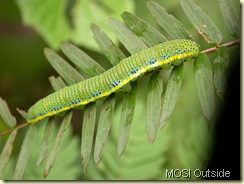
Wildlife Use: Partridge pea is important as the larval host plant of several sulphur butterflies (Giant Cloudless, Little yellow, and Orange Sulphurs). (Check out Kristen’s Butterfly blog Lepcurious for a post on other host plants for sulphur butterflies) Seeds of partridge pea are important part of the diet of quail particularly in the Midwest. The plant as a whole is preferred white tailed deer browse.

DSCN9323 DSCN9314 Cloudless Sulphur larvae

Field ID: Partridge peas are in bloom throughout the summer months and are easily recognized by their bright yellow flowers and small pinnate foliage.

Information: Previously known as Cassia fasciculata, Chamaecrista fasciculata is a nitrogen fixing legume. It is commonly planted for soil stabilization and improvement projects. The small nectar gland at the base of each leaf attracts ant species which may in turn protect the plant from herbivores and plant damaging insects. Partridge pea has a long history in Native American culture as a medicinal plant but; partridge pea can be a purgative in humans and is toxic to livestock. So once again, let’s leave this one for the birds, bees, and butterflies.

References and Additional Resources:

  • Austin, Daniel F. Florida Ethnobotany. Boca Raton: CRC Press. 2004
  • Miller, James H., and Karl V. Miller. Forest Plants of the Southeast and Their Wildlife Uses. Athens and London: University of Georgia Press. 2005
  • Taylor, Walter K. The Guide to Florida Wildflowers. Dallas: Taylor Publishing Company. 1992
  • NPIN Native Plant Database Chamaecrista fasciculata
  • Illinois Wild Flowers Chamaecrista fasciculata
  • USDA Plants Profile Chamaecrista fasciculata

Monday, August 31, 2009

Box Turtle of a Different Stripe

DSCN9299

Zipping through the trails on the gator to gather up some fern fronds, I nearly made this little guy a speed bump. At first glance he looked a little like a box turtle in the wrong colored shell (sans stripes). With a tan carapace with no markings, orange red scales on his legs, and a vivid red head I was stumped… It didn’t help that although he had a hinged plastron (pretty good id for a box turtle), this little guy was having nothing to do sealing him self safely inside his shell. Rather, as Kristen from over at Lepcurious so aptly titled this photo…this little guy was in a perpetual state of “Raaaaawrrrr!!!”

We decided to let this bundle of attitude wrapped in keratin and bone have his way with the Back Woods. From what I have read, this particular sub species of box turtle (Terrapene carolina triunguis) otherwise known as the three toed box turtle is only found in the panhandle of Florida. Being well south of his natural range, it is possible that this animal is an escaped or released pet. (Please don’t let ANY pet trade or domesticated animal go in the wild) Had I paid a little closer attention to his range we might have found him a home elsewhere. We’ll call it my karmic balance for the Bufo marinus in the freezer today…but that is another story.

Check out our Facebook page for the dramatic release into the Back Woods

Monday, August 24, 2009

USF Community Plunge

DSCN9262 

Once again students from USF volunteered their time to help the Back Woods and MOSI as part of the their commitment to Tampa Bay in USF’s annual Community Plunge!

DSCN9250_stitchWith thunderstorms looming on the horizon, the students dove into clearing vegetation from the entry to future wetland boardwalk and observation platform. Armed with loppers, hand saws, sling blades, and machetes the students made short work of years of growth of invasive species and weedy brush.

DSCN9260  Their efforts removed nearly 15 yards of brush and invasives from the woods! And, thanks to the services of A&D Recycling and Mothers Organics composting facility all of the material cleared will be composted and re-used rather than land filled or burned.

Soaked to the gills and filthy from top to bottom at the end of the morning, these Bulls proved themselves real troopers! MOSI and the Back Woods are truly grateful for all the volunteer’s efforts and hope to work with many of them in the future.