Four days passed between the capture of these two panoramas looking over the smaller sinkhole. To me, this really illustrates the importance of protecting the quality of surface waters. The water on the surface four days ago has percolated down through a sand column to the Floridan aquifer. It is quite likely bubbling up in Sulphur Springs, spilling out into Hillsborough River, and flowing into Tampa Bay.
Follow the epic tale of restoration and conservation of an urban forest on the campus of the Museum of Science & Industry in Tampa.
Wednesday, July 15, 2009
Wednesday, July 1, 2009
Plant Profile: Buttonbush
Common Name: Buttonbush
Scientific Name: Cephalanthus occidentalis L.
Form: Deciduous scrubby arching shrub
Height/Spread: 10-12 ft tall (upwards as high as 20 ft), spread similar to height.
Leaves: Deciduous, simple, entire margin, ovate to elliptical shape with acute tip and rounded (obtuse) base, opposite arrangement (sometimes in whorls of 3), dark green glabrous above sometimes minutely pubescent (hairy) below.
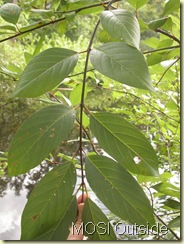
Twigs: New twigs reddish brown, slightly haired to hairless with raised corky lenticels.
Bark: Older twigs and larger stems grayish, rough, and fissured.
Flowers: Numerous fragrant small white flowers arranged in a dense globe. Stamens projecting from the cluster give it a pincushion like appearance. Flowers are borne in loose cymes typically at the end and axis of new growth. Blooms throughout the summer months; June through September.
Fruit and Seeds: Globose cluster of nutlets
Habitat : Buttonbush is an obligate wetland shrub to be found in swamps, marshes, forested wetlands and along the borders of lakes, streams and ponds.
Range: Eastern Canada to Florida and west to California, Mexico, and Cuba. Found throughout Florida.
Shade Tolerance: Tolerant
Fire Tolerance: Not tolerant. May re-sprout following fire.
Wildlife Use: Waterfowl and shorebirds consume the fruit. Bees and butterflies collect pollen and nectar from flowers.
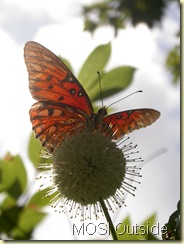
Field ID: Buttonbush is easily recognized by its opposite or whorled leaf arrangement and or the presence of the globose white flower heads and globose fruit. Buttonbush is an obligate wetland species.
Information: The scientific name for buttonbush, Cephalanthus is from the Greek Kephale for head and anthos for flower. The globe like cluster of flowers do resemble old style globular buttons which may reveal the derivation of the common name. The Miccosukee of Florida called buttonbush “alligator shader” which seems appropriate considering their common locale along lake or river edges. Native Americans throughout the Eastern US found many medicinal uses for buttonbush. Recent analysis of the chemistry of buttonbush has revealed gylcosides that can be toxic to humans and livestock. So, leave this one for bees and butterflies.
References and Additional Resources:
- Austin, Daniel F. Florida Ethnobotany. Boca Raton: CRC Press. 2004
- Floridata record Cephalanthus occidentalis
- Godfrey, Robert K. Trees, Shrubs, and Woody Vines of Northern Florida and Adjacent Georgia and Alabama. Athens and London: University of Georgia Press. 1988
- Miller, James H., and Karl V. Miller. Forest Plants of the Southeast and Their Wildlife Uses. Athens and London: University of Georgia Press. 2005
- MOBOT Plant Finder Cephalanthus occidentalis
- NPIN Native Plant Database Cephalanthus occidentalis
- Tiner, Ralph W. Field Guide to Coastal Wetland Plants of the Southeastern United States. Amherst: University of Massachusetts Press. 1993
- UF/IFAS Fact Sheet Cephalanthus occidentalis
- USDA Plants Profile Cephalanthus occidentalis
- US Forest Service Database Cephalanthus occidentalis
- Virginia Tech Tree ID Cephalanthus occidentalis
Tuesday, June 16, 2009
Gordonia lasianthus
With a name like that, it has to be cool.
And, it is! The loblolly bay (Gordonia lasianthus) are in bloom in the Back Woods. The white saucer like blossoms might look somewhat like small magnolia flowers but, they are of no relation. Loblolly bay are actually in the tea family (Theaceae) and are related to the ornamental camellia that you may have in your yard and the camellia cultivated for the production of tea. Loblolly bay can reach heights up to 65 feet. They prefer wet, poorly drained acid soils and are commonly found in wet flatwoods forest systems. The blooming period of loblolly is fairly short (usually just June through July) and individual flowers last only a day or two. So, now is the time to stop by the Back Woods and catch a glimpse of this flatwoods beauty before the show is over.
Monday, June 15, 2009
Flickers and Cicada Killers
I spotted a yellow shafted flicker (Colaptes auratus) this morning along the trail in the southern portion of the woods. This bird was unmistakable with its bright white rump noticeable as it flew off from the trail and the tiny red patch visible on the back of its head as it lit into a tree. Although not threatened, flicker populations have been noted to be on the decline. Protecting and maintaining nesting snags (dead trees) in the forest, parks, and other natural areas can be helpful in protecting populations of flickers in our area. This is one more new species for the Back Woods list of visitors and residents.
The cicada killers are emerging and are notable through out the forest. Dodging them is sometimes a challenge. It can be an even greater challenge when they are weighed down in flight with a cicada in their grasp! Check out Prof. Chuck Holliday's Cicada Killer Page for more info on these really cool wasps.
Friday, June 12, 2009
Another Day in the Woods
I just knew today was going to be a little absurd. You know the feeling… you are sure everything is going to be slightly askew. With that thought in mind, a grin on my face, and loppers in hand I headed for the woods. My heart sank in the sandhill when I saw what appeared to be one of the larger adult gopher tortoise dead in the mouth of a burrow a little too small for it. The burrow was collapsed at the top and the apron and surrounding bare sand held imprints of dog paws. Reaching in to the burrow to retrieve the body I was treated to a hiss and flip of sand by a still kicking tortoise. Fortunately our little guy had survived but was obviously exhausted by the ordeal of escaping from a domestic dog and still with back to wall per se wedged in a too small burrow. I left it be and happy to find it recovered later in the day. Dealing with free roaming domestic animals, other feral non native animals, and even some native predator species are some of the greatest challenges to maintaining a natural area for native wildlife in urban areas. Gopher tortoises are susceptible to predation from dogs, cats, armadillo, opossum, and raccoons. All of these animals are known to predate juvenile tortoise and eggs while dogs pose the greatest threat to adult tortoise. Forgive me if I am repetitive in the message of being a responsible pet owner. Please do not allow your domestic animals to roam free. Most of the animals we consider as pets are predators and no matter how well fed will prey on any native wildlife they come upon. Never release unwanted pets in the wild. Domestic pets dumped in the wild are subject to injury and death from other animals and disease. Of course spay and neuter to prevent reproduction should your pet get out or get away. Preaching done, thanks.
How is it that a plant this pretty is such a pain in the back side?! My perpetual nemesis the air potato (Dioscorea bulbifera) is on the come back after the treatments of last fall and spring. This PDF on Air Potato Management in Florida tells you all you need to know and more about air potato. Should you happen to feel the need to enact your own form of vengeance on this pernicious example of flora; I would welcome any assistance in maintaining control of this green monster in the Back Woods. Potential attacks could come in the form of air potato pick ups, hand pulling vines, or machete meets vine action and I’ll bring up the rear with the herbicides. In the process, you will hopefully come across a few examples of the resident wildlife, flowering native plants, and donate a few thimbles of blood to the mosquito population. Possibly you might find an interesting artifact or two.
What an odd little find. This strange little “bird” figurine almost looked like a mummified bird body when I first came across it in the leaf litter. A closer look around revealed several other old plastic toys and children’s items long ago discarded in another one of the Back Woods’ remnant trash heaps. All of this was beneath a very nifty toppled laurel oak (Quercus laurifolia), with a 10 foot diameter pancake of upturned root system, still happily growing horizontally.
Also beneath the oak was a smattering of Virginia chain fern (Woodwardia virginica) and even a clump of royal fern (Osmunda regalis). I really need to buff up on my ferns again. It’s all about venation and where the sori are! (LOL) A nice online key to ferns in southwest Florida can be found on the Audubon Corkscrew Swamp Sanctuary website.
(plant nerd alert) And then I looked up to see a sprig of inequilaterally based, doubly serrate margined, distinctly parallel veined leaves and shouted to the sky, “It’s an elm!” To the west of the sinkhole complex there are several long dead snags of American elms (Ulmus americana) (now charred from the brush fire) but I have not come across a single live American elm anywhere on the property. Now, low and behold, one skinny little sapling was arching its way out of the weedy brush towards the light right in front of me. It had taken advantage of growing space provided by the falling of that big laurel oak mentioned earlier and was holding its own against the smother of elderberry and wax myrtle (Morella cerifera). Yay, new tree species to add to diversity of the site.
I leave with you the simple raceme of gopher apple (Licania michauxii). One of my favorite plants (aren’t they all). These petite blossoms will give way to a delicious ( to the peculiar palate) white egg shape fruit. The taste is some what reminiscent of the philodendron Monstera deliciosa and simultaneously of that of something overripe. A couple of fairly large patches of gopher apple are really putting on a show right now in the western sandhill. There should be lots of fruit for the gopher tortoise with maybe a few left over for me.
Happy weekend. Get outside!
Wednesday, June 10, 2009
Playing in the Woods
Volunteers have been pivotal in helping us achieve some of the clean up and restoration goals in the Back Woods. We have opportunities for interested and dedicated individuals to serve on a reoccurring basis and help us with day to day maintenance and restoration. Want to come play in the woods a day or a few days a month this summer? We currently have up to 10 openings for volunteers to be Forest Stewards for the Back Woods.
Volunteer Forest Steward opportunities:
Volunteer opportunities are open to individuals who can commit to a minimum of once a month service on a reoccurring basis. One time group projects can be coordinated.
Preservation Steward
Position description: Preservation stewards may be involved in trail construction and maintenance, boardwalk construction and maintenance, native plantings, invasive plant removal, habitat protection, and basic forest upkeep.
Requirements: Must be at least 18 years of age and capable of working out-of-doors year round in extremes of temperature. Position requires a moderate to high level of physical capability. Previous experience with landscape related hand tools and power tools helpful but not required. Closed toe shoes and long pants are required year round.
Shifts: Monday through Friday 8am to noon as available
Monitoring Steward
Position description: Monitoring Stewards may be involved in collecting data on the plants and animals present in the Back Woods, establishing photo reference points to track habitat changes, quantitative measure of plant populations, updating database records, locating and recording positions of invasive species, and assisting in basic forest upkeep.
Requirements: Must be at least 18 years of age and capable of working out-of-doors year round in extremes of temperature. Position requires a moderate to high level of physical capability. Knowledge of Central Florida plant/animal species and habitat types helpful but not necessary. Closed toe shoes and long pants are required year round.
Shifts: Monday through Friday 8am to noon as available
Outreach Steward (Coming Soon)
Position description: Outreach Stewards may be involved in docent activities in the Back Woods including; conducting nature walks and developing/delivering natural resource related talks for MOSI guests, school groups and the general public.
Requirements: Must be at least 18 years of age and capable of working out-of-doors year round in extremes of temperature. Position requires a moderate to high level of physical capability. Working knowledge of Central Florida native flora, fauna, and habitats preferred. Closed toe shoes and long pants are required year round.
Shifts: Variable daytime shifts and weekends may be available as the program develops.
Please contact Carolyn at crhodes@mosi.org for more information on volunteer positions.
Turtle Crossing Merit Badge
If you live in Florida, you have no doubt already earned your helping a turtle cross the street merit badge a hundred times over. Once again I was called into action. Along with requisite consumption of two very strong cups of coffee, this mornings duties included helping a turtle navigate a daunting curb after crossing the street. Although I sure this Florida box turtle (Terrapene carolina bauri) would have been quite capable of navigating along the curb until he came to grass again; I really didn’t want him to spend that much time on the roadway with the all the summer school traffic coming in this morning. And of course it gives me an excuse to share him with you.
A very easy to ID turtle in the field; the Florida box turtle has a very dark brown carapace (top of the shell) with bright yellow striations. This little guy was also easily identified as a male from the deep indentation at the rear of the plastron (belly of the shell). Another neat feature of the box turtle is the hinge on the forward portion of the plastron which allows the box turtle to nearly seal himself in completely.
Not previously noted in any historical wildlife sightings in the Back Woods; this Florida box turtle is a welcome addition to our little forest home.