This is part II of our three part post, Battle for the Back Woods, discussing many of the non native invasive plant species that are impacting the natural systems of the Back Woods. Part I discussed non native and invasive vines which top our list of plants threatening our little woods. With part II we take a look at a few non native shrub, herb, and grass species that are in the middle of our list bothersome plants…
In these posts you will see reference to Category I and Category II invasive species. These designations are defined as follows by the Florida Exotic Pest Plant Council (FLEPPC).
Invasive exotic plants are termed Category I invasives when they are altering native plant communities by displacing native species, changing community structures or ecological functions, or hybridizing with natives. This definition does not rely on the economic severity or geographic range of the problem, but on the documented ecological damage caused. Category II invasive exotics have increased in abundance or frequency but have not yet altered Florida plant communities to the extent shown by Category I species. These species may become Category I if ecological damage is demonstrated.
Many of these shrubby, herbaceous, and grassy species are considered serious and difficult to control pests. We place them in the middle of list of bothersome plants because most, with the exception Boston fern and primrosewillow, appear in very limited and so far controllable patches in the woods. Not an all inclusive list, these are our top seven herbs, shrubs, and grasses in descending order from the most pestiferous in the Back Woods.
 Boston fern (Nephrolepis cordifolia), introduced to Florida from the ornamental plant trade, has been a serious problem in the Back Woods. As part of our restoration grant through the EPC of Hillsborough County, we were able to hire an herbicide contractor that helped us put a serious hurt on some fairly significant areas of dense fern populations. But because this Category I species can be persistent, returning from tuberous root systems or germinating from the thousands of spores released from fertile fronds, we have to be vigilant in our follow up control measures. Hand pulling and herbiciding are the primary means of control. Volunteers are welcome always to help us hand pull this readily identifiable species.
 Peruvian primrosewillow (Ludwigia peruviana), an obligate wetland species, has found a foothold in many of the wet areas of the Back Woods. Primrosewillow has beautiful four petalled yellow blossoms nearly year round. Unfortunately the flowers of this Category I species are followed by large angled capsules that can sow the seed bank with millions (yes millions) of seeds. The plants themselves are pretty persistent even after application of herbicides. We cut and stump treat to make a dent in the population yearly. I am not sure we will ever completely eradicate it from the wetlands.
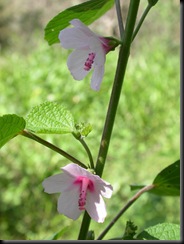 Caesar weed (Urena lobata) can be found most everywhere that is not overly wet in the Back Woods. While taking measures to control a wildfire that occurred in the Back Woods last year, the DOF put a plow line in around the sinkhole complex. Every inch of that disturbed bare soil erupted Caesar weed. Only a Category II species, Caesar weed is still very pioneering meaning it can rapidly fill any new openings or disturbed areas out competing other species for growing space. Volunteers have helped us hand pull thousands of square feet of Caesar weed in an effort to control its spread. Caesar weed produces fruit with hooked barbs that cling to the fur of passing animals or to just about any clothing as well as human hair. Part of our continuing challenge is to treat this species before it sets fruit and to take care not to spread the fruit ourselves.
 Rose Natal grass (Melinis repens) is a Category I invasive species that poses a threat to our sandhill habitats in the Back Woods. Adapted to arid conditions like those in the sandhill, this grass can displace the native grasses that are an important food source for our threatened gopher tortoises. Natal grass can spread quickly into disturbed areas making it particularly challenging for us as we try to thin the oak canopy around the existing sandhill and open up/expand the sandhill habitats. Hand pulling this grass appears to be the most effective form of control in the Back Woods. But it is often difficult for volunteers (and me too) to distinguish this plant from other grasses when not in bloom.
 Lantana (Lantana camara), a very popular and attractive ornamental, has been introduced worldwide from its origin in the West Indies. Found almost everywhere in Florida, Lantana camara is capable of hybridizing with our at least one of our three native lantanas (Lantana depressa) threatening the genetic integrity of this endangered species and making control of the non native more difficult. This Category I invasive species is spread by animals and birds relocating the fruit/seed. Repeated treatment of individual plants and new recruits are key to its control in the Back Woods. If you plant non native ornamental hybrids of lantana, look for sterile varieties or better yet plant the common native buttonsage (Lantana involucrata) instead. Check out this very interesting article on distinguishing native and non native lantana species.
 Brazilian pepper (Schinus terebinthifolius) is not only a Category I invasive species but, finds itself listed on the 100 of the World's Worst Invasive Alien Species on the Global Invasive Species Database. Brazilian pepper could be the picture beside the definition of a Category I invasive species. It forms dense monocultures that suppress all other plant growth through sheer biomass as well as allelopathic chemicals. Cutting and stump treating the plants has worked so far but potential for reintroduction from birds or mammals from nearby sources is always likely. Fortunately for us, Brazilian pepper is spotty in just a couple of areas along the wetland margins. This ecosystem altering invasive species has actually become a notable component in honey production in Florida, providing nectar for honey bees in the winter months and producing a locally popular (one of my favorites) peppery honey.
 Cogongrass (Imperata cylindrica) is a Category I species. It is so bad… it has its own website! This nasty found its way to the US South as a packing material, forage crop, and ornamental. Cogon grass forms dense monocultures that exclude other plants and may even inhibit ground dwelling/nesting animal species. Cogon grass is adapted to survive in an environment with fire. Unfortunately, it can also alter native fire regimes by burning more intensely than than native grass species damaging otherwise fire resistant/tolerant plants and soils. Fortunately for us, cogongrass has only cropped up in a spot or two. Pulling and herbiciding has controlled it so far. There is the potential it could be reintroduced from seeds blowing in from outside sources. Cogongrass is easy to id when in bloom by its long cylindrical fluffy seed head or by its leaf blades which have a finely serrated edge (feel not see) and the noticeably off center midrib (see the photo).
NEXT WEEK…Non native invasive tree species inhabit a few pockets of the Back Woods but have been the least of our concern and so far have been fairly easily controlled with herbicide and a chainsaw ;-).
Some of the common names I use may seem unfamiliar or appear to be a variation of a more familiar common name for the plants discussed. I try to use the common names as well as the currently listed scientific name as listed on the Atlas of Florida Vascular Plants as a convention to keep our naming and references consistent in this blog.
 WE WANT YOU: If you are looking for a great work out (pulling up plants and wielding loppers) we are always looking for intrepid VOLUNTEERS to help us out in our battle against invasives. Current opportunities M-F 7am-4pm.


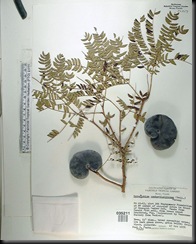 Earpod tree
 Camphor tree


